
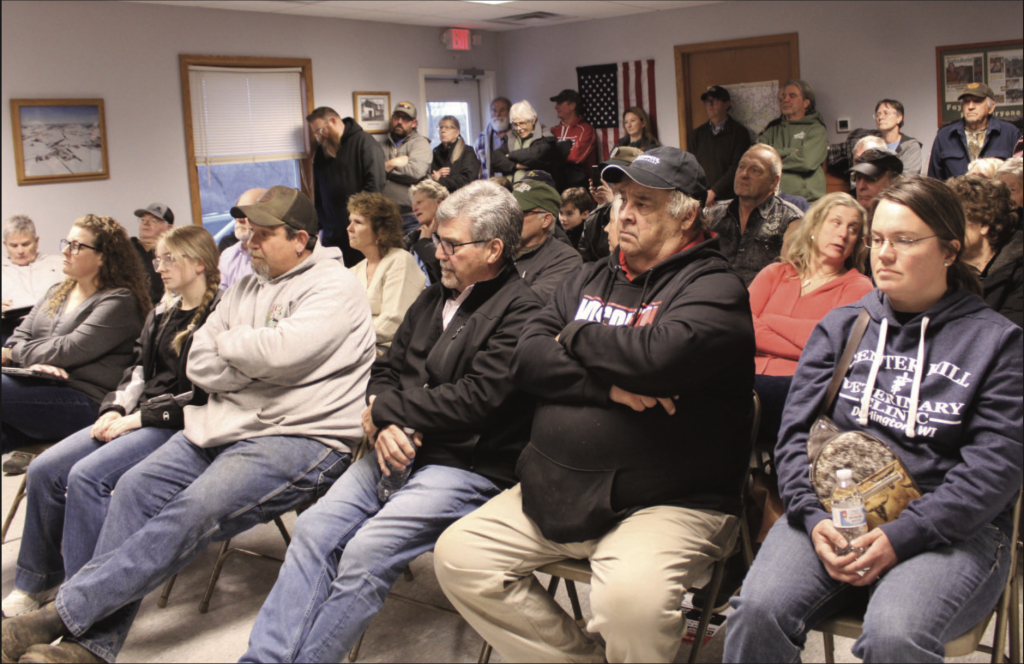
The two hour meeting held on Thursday, February 19 at Fayette Township hall was filled wall to wall with concerned citizens wanting answers to questions about the Uplands East Wind Farm that Pattern Energy is looking to build in portions of Fayette.
Members of the Fayette Township Board welcomed Pattern Energy representatives Michael Goff and Patrick Gehl to talk about Pattern Energy, the Uplands East Wind Farm and where they are at in their project.
The $1 billion Uplands Wind project is spread across central and southern Iowa County and portions of northern Lafayette County, looking to have over 50 turbines and generate around 300 megawatts of energy. There are 64 locations for turbines acquired so those additional 14 locations are considered alternates. According to the map from Pattern Energy, around 11 turbines would be located in Fayette.
The turbines will be between 3 megawatt and 6.5 megawatt, where they could be close to 650 feet tall. Pattern Energy has not decided which turbine model they will be putting up, as they need to do more analysis of the area.
Pattern Energy has sent out their 90 day notice, which is a requirement of the Public Service Commission (PSC) before they are to get their permit for the right to build. There are still several surveys that need to be done (wind, noise, environmental, etc.). The project will have 12-14 months to go through the PSC process. Once they are approved, the construction phase will take around two years, with the hope of being up and running by 2030.
Board member Stu Soper came prepared for the meeting with several pages of questions about the project, from noise studies, flickering lights, setbacks, road access, access to EMS, endangered species, run-off, decommission, etc.
One big question that wasn’t quite answered was why here; why this part of southwest Wisconsin. Fayette resident Howard Hill, an environmental science instructor at Loyola University-Chicago, brought up wind studies done that show how this area has meteorological wind channels. These channels are created due to terrain, like hills and valleys, and significantly impact wind turbine performance by intensifying wind speeds and increasing turbulence. Howard gave examples of the Madison and Kenosha areas, where their wind speeds were considered high, as this area only sees moderate wind speeds.
The karst topography of the land was a much discussed topic. Karst topography is created by soluble rocks like limestone, dolomite and gypsum, forming sinkholes, caves, disappearing streams, and springs. Attendees asked how Pattern Energy is able to put the wind towers on this land when they don’t know what is under the ground. Goff alluded to following all of the maps and guidelines of the Wisconsin Department of Natural Resources (DNR). They will adhere to all of the permits and processes required of them to make certain they are building on land that will hold up the turbines. Goff added that is why they have alternative places in mind just in case.
They will also adhere to the DNR for their setbacks from endangered species, especially around Yellowstone Lake State Park, where thereare home to 4,000 little brown bats, often found on the threatened or endangered species due to white-nose syndrome. They are also home toover 170 different species of birds and many different species of wildlife and see close to 250,000 visitors each year to the 450-acre park.
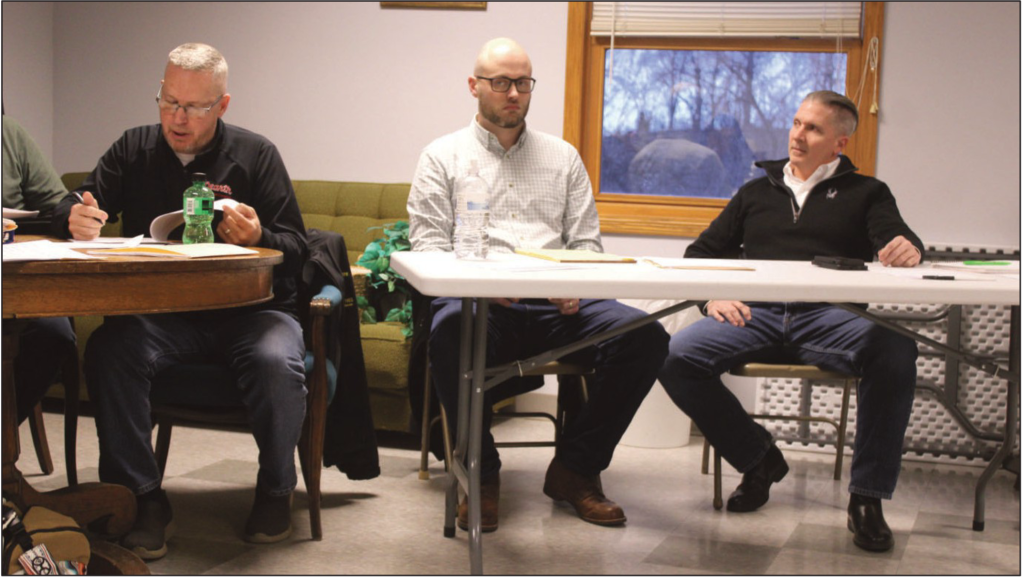
Township board member Stuart Soper asked about noise studies being done, flickering lights from the towers, ice throw studies due to the amount of people that visit the park each year and the area residents that will be near the proposed wind turbines,
“We are just here to protect our people,” Soper said.
Goff stated those are the next steps they plan to do. At the end of January, Pattern Energy sent out 90-day notices to all those residents and land owners impacted by the turbines, as is required by the PSC. After those 90 days is when they intend on filing their application to the PSC for the right to build the turbines. During the 12-14 month waiting period they will do more investigations and studies.
One attendee felt there was nothing the township could do to stop Pattern Energy. “No matter what we say or what we want to do…they can come in and do whatever they want because the state came in and took away our local control.”
Goff reassured that the energy created from the wind turbines will be staying in Wisconsin. It has not been identified where in the state it will be going but Goff stated that their commitment is to keep it in Wisconsin.
Attendees argued that the energy may stay in Wisconsin but the profits from the company doesn’t even stay within the United States. Pattern Energy has their headquarters based in San Francisco, Calif., but their investors into the company are from Canada, Australia and the Netherlands.
“Your company has but us all on edge…and put neighbor against neighbor,” one attendee stated.
Lisa Braley resident said that it is sad that they are at this point.
“A majority of these people would tell you to get in your car and get out of here,” Braley said. “This isn’t right for our township nor do we want it in our township yet you won’t listen to us.”
The wind farm is expected to last up to 40 years. The board questioned what will the township be in charge of when the project and turbines are decommissioned. Goff stated he didn’t know the cost of anything that far in advanced as it was all based on the bonds put on the project. The entire turbine will be taken down and many of the parts will be recycled. For the decommissioning process, the will remove concrete only four feet down. The rest will stay in the ground. Depending on the size of the towers, they could pour up to 30 feet of concrete into the ground, so the rest of that concrete and rebar will remain underground after the towers are decommissioned.
Braley questioned if any of their projects have contaminated any water. Goff stated there was concern at one project about contaminated water but they were found to not be at fault and there was no wrong doing on their part.
Township president Bob Hermanson asked if those who signed leasing agreements with Pattern Energy understood that amount of concrete would be left in their land. Goff stated yes, all that information was in the contract.
Pattern Energy is also working with the FAA (Federal Aviation Administration) on having towers with ADLS (Aviation Detection Lighting System) that will keep the lights off on the towers unless a low flying aircraft is in the area. That has not been approved and not all ofthe towers will have the system installed.
“We all live out here for a reason; it is beautiful. Now I’m going to have red flashing lights coming in my windows that should be looking out and the beautiful countryside.”
They argued they wanted a better map so they know for sure where the turbines will be put up so they can make plans, like possibly moving.
“Just give us the basic two things of information we want, setbacks and locations,” one attendee argued.
To answer the question of why this place, attendees argued it was because they were thought of as “dumb farmers who could be taken advantage of to get what they want”.
There is a time and a place for public comment on this topic. After the 90 days, Pattern Energy will submit their full application for consideration. During that time a docket is formed where people can go and make public comments and address all of their issues and submit that to the PSC. This is all public records. Goff stated that the docket should be available early. The docket will be available on the PSC website under “Commission Actions” and “File a Public Comment”. It will also be on the Upland Winds LLC website.
Braley said she moved to this area because of the views, the privacy, and the animals.
“This is not a done deal by any means. We are going to fight until the end. We need to protect this area for all of us. This place is incredible,” Braley said.